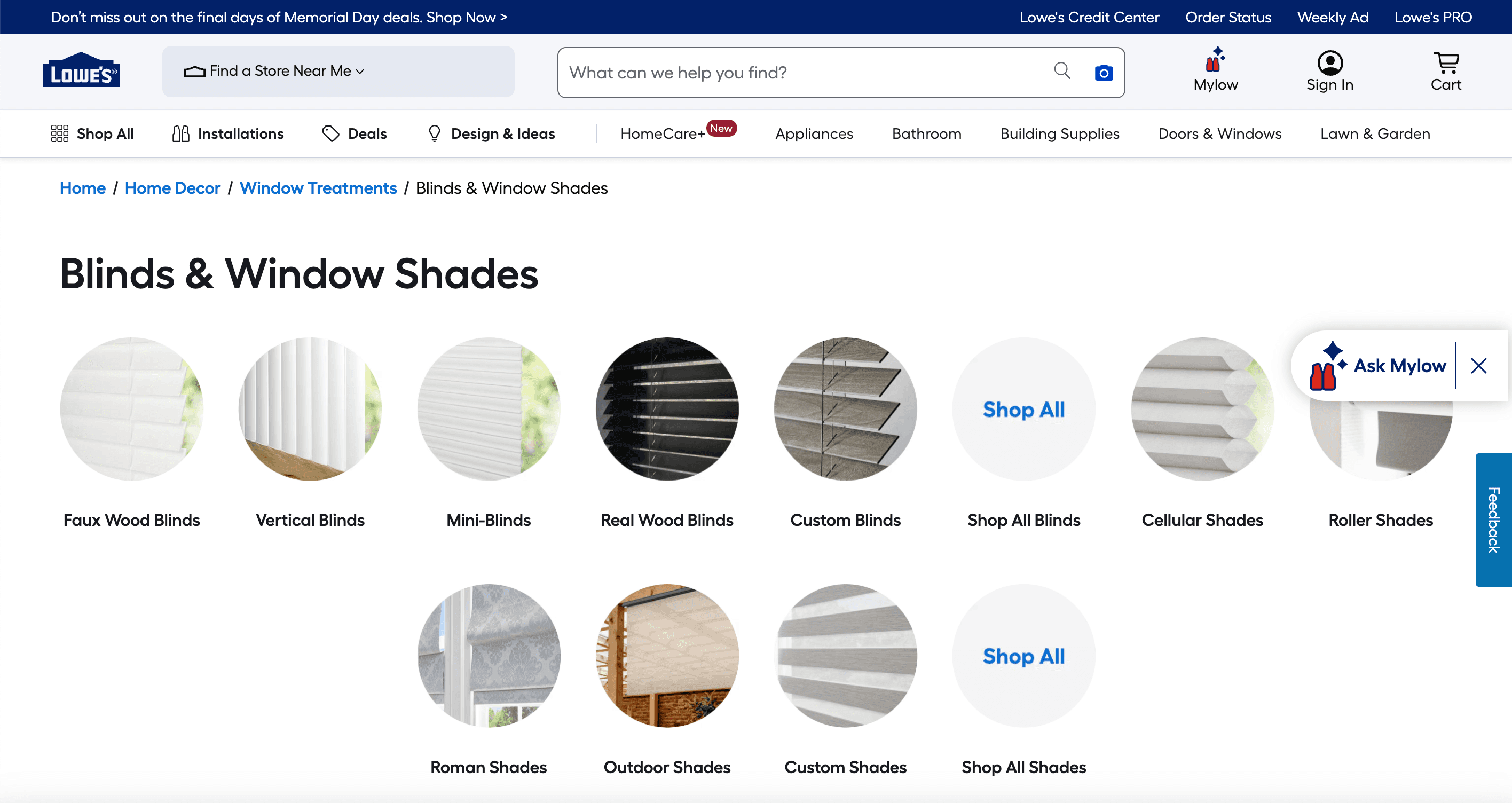
Lowe's Blinds & Shades experience sat at the intersection of inspiration, measurement, customization, and confidence, but customers struggled to understand their options, configure products correctly, and move from browsing to purchase.
I led foundational research to diagnose where the journey was breaking down, identify the highest-impact opportunities across the buying flow, and align category, product, design, and merchandising partners around a clearer experience strategy.
Role
Sr. UX Researcher
Timeline
2 months · 2023
Partners
Sr. Designer, Content Strategist, Sr. Product Manager
Stakeholders
- Category Management Leads
- Merchants
Methods utilized to diagnose & prioritize
Decision supported
What should Lowe's prioritize to reduce friction, increase customer confidence, and improve the path from category exploration to configuration and purchase?
Why this mattered
A high-consideration category built on many decisions
Blinds & Shades is a high-consideration category where customers need to make several decisions before they can confidently purchase: style, mount type, measurements, light control, material, color, customization, and installation.
The business needed to know where experience improvements would create the most confidence and reduce friction before investing in a redesigned category journey.
The challenge
Define a research strategy to support Lowe's ambition to lead in the Blinds & Shades category by uncovering key customer barriers and opportunities to increase confidence, drive conversion, and streamline the omni-channel experience.
Research goals
- Uncover the key customer barriers in the Blinds & Shades buying journey.
- Identify opportunities to increase shopping confidence.
- Prioritize the experience improvements most likely to drive conversion.
- Streamline the omni-channel experience across online and in-store.
My research strategy
A learning agenda built around three levels of decision-making
Rather than running studies in isolation, I designed the plan so each phase answered a distinct question the team needed resolved before it could act.
Journey diagnosis
Where were customers losing confidence across inspiration, selection, configuration, and purchase?
Opportunity sizing
Which pain points were most common, most severe, and most likely to influence roadmap priority?
Concept & flow validation
Which experience changes helped customers move forward with more confidence?
What we learned
Four insights that reframed the problem
Customers needed decision support before they were ready to configure.
Why it mattered
Shoppers were not just looking for products. They were trying to understand which type of blind or shade fit their room, light-control needs, privacy expectations, and installation comfort.
Experience implication
The experience needed to support education and comparison earlier in the journey, not only customization on the product detail page.
Measurement and mount type created confidence gaps.
Why it mattered
Customers hesitated when they were unsure whether they were choosing the right mount type or entering measurements correctly.
Experience implication
Guidance around measurement, mount type, and customization needed to be clearer and easier to access at the moments where customers were making those decisions.
The list page was not helping customers narrow choices.
Why it mattered
Customers needed clearer filtering, comparison, and category-level education before selecting a product.
Experience implication
The category experience needed to help customers understand the assortment and narrow options before they reached configuration.
The configurator carried too much of the burden.
Why it mattered
By the time customers reached configuration, they still had unresolved questions that should have been answered earlier in the journey.
Experience implication
The buying journey needed to be more connected across category pages, list pages, product pages, and configuration.
Opportunity framework
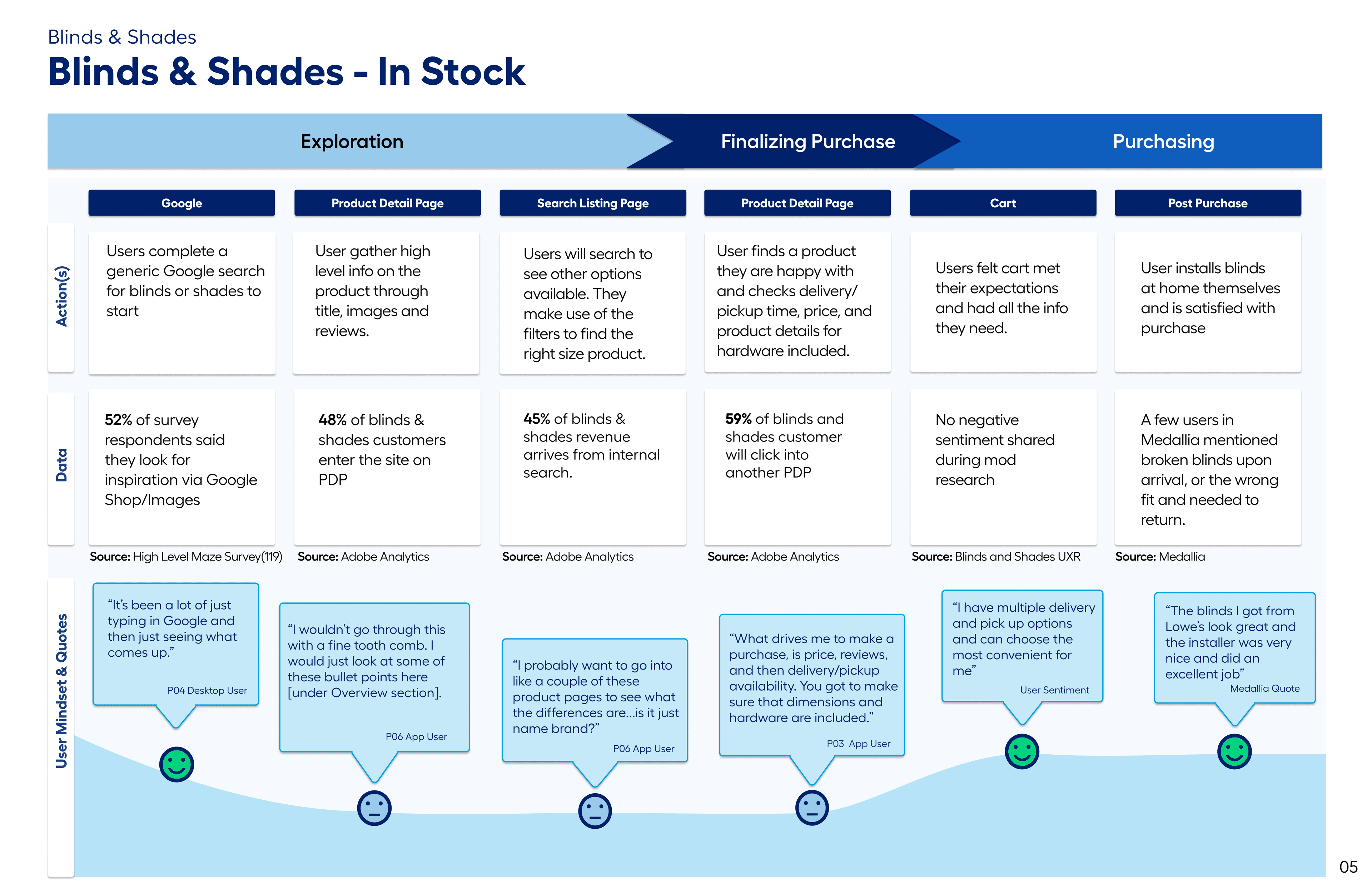
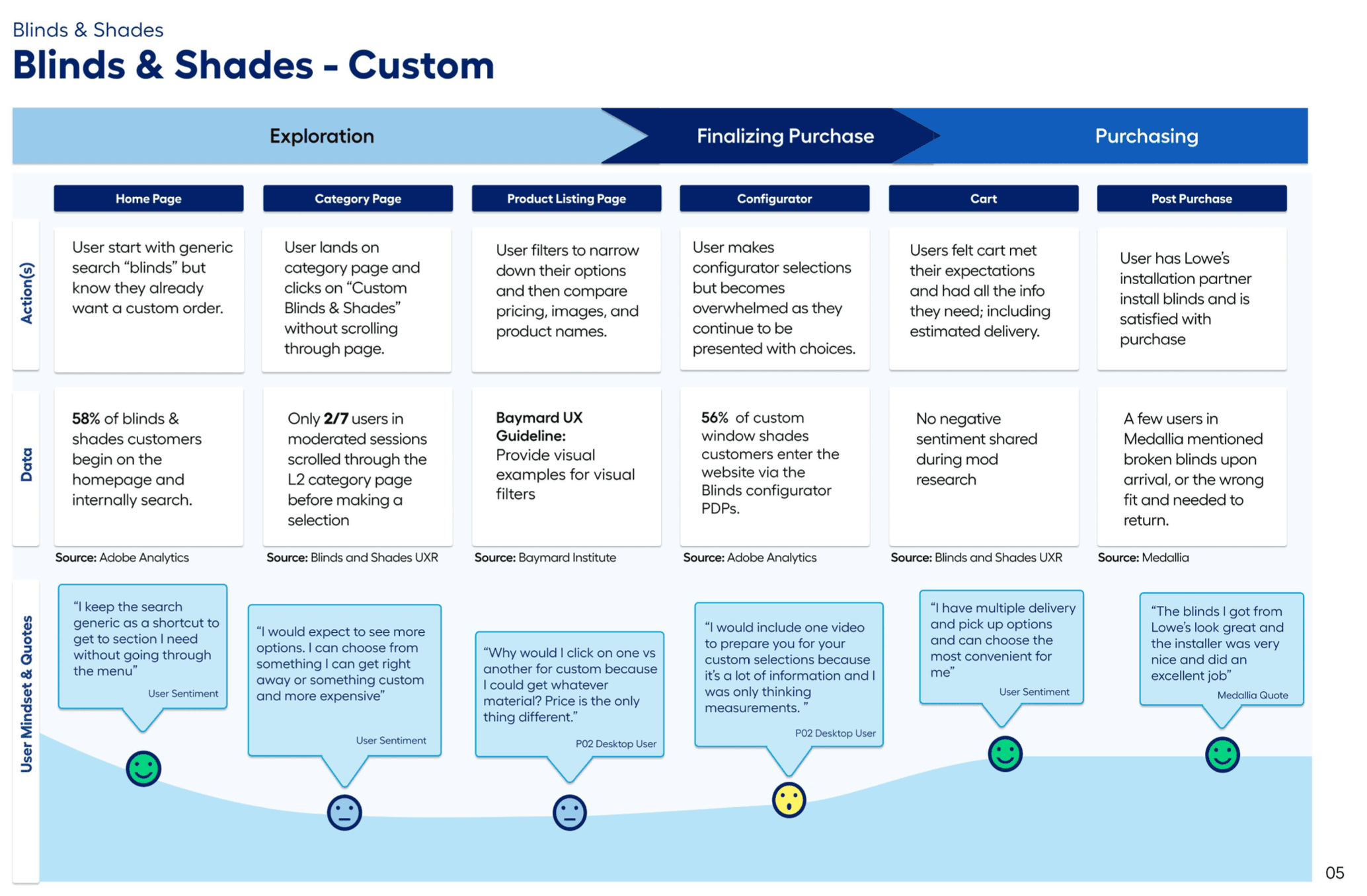
Mapping confidence gaps across the buying journey
Unsure which blind or shade type fits the room.
Hard to narrow options and grasp the assortment.
Uncertain how to measure correctly.
Mount type and customization create hesitation.
Lingering questions slow the move to checkout.
Worry about installing it correctly.
Prioritizing opportunities
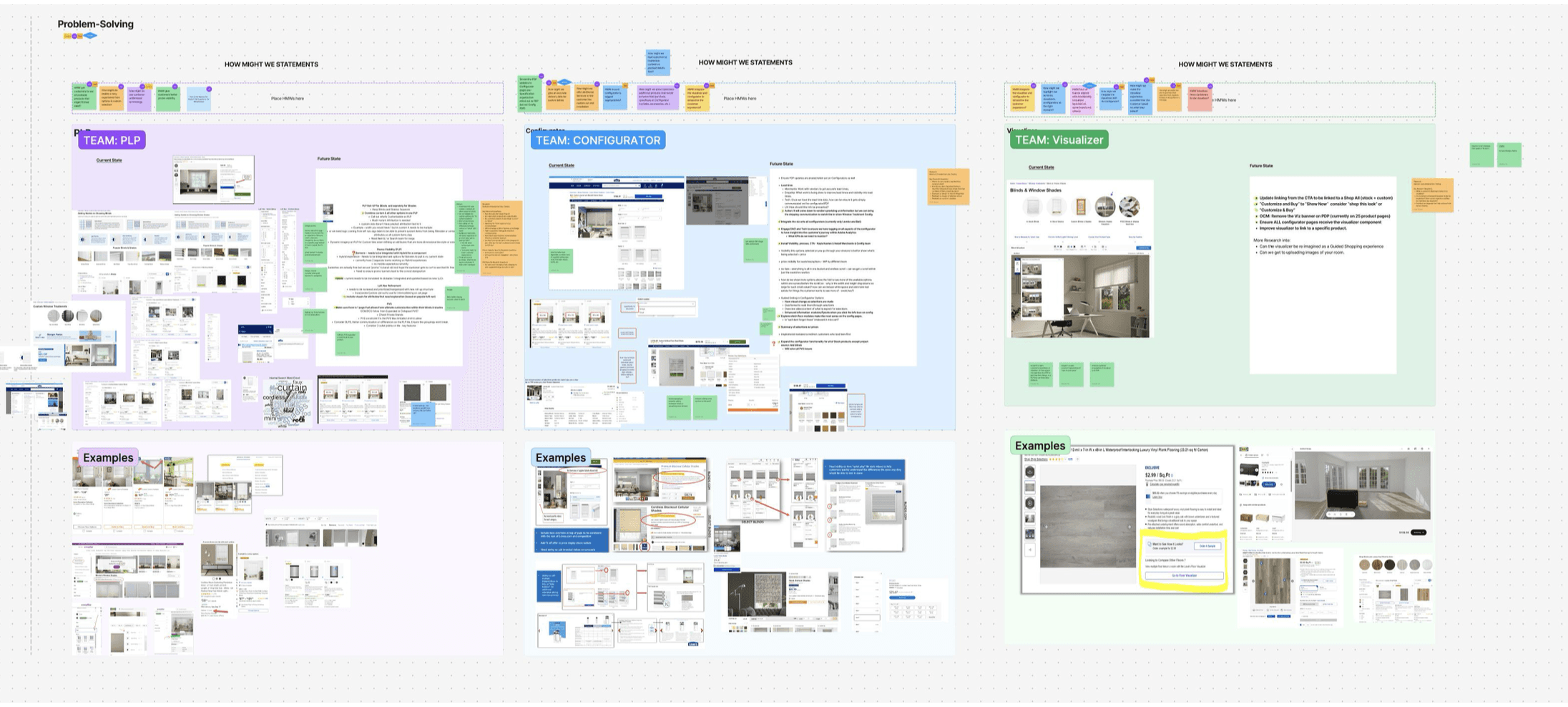
I scored opportunities by customer pain severity and business and conversion opportunity to focus the roadmap on what mattered most.
Measurement guidance
Mount type education
Product comparison
Configurator clarity
Filter / list page improvements
Installation confidence
My leadership & impact
How I led the work
- Reframed the project from a page-level optimization effort into a category journey strategy focused on customer confidence, decision support, and conversion friction.
- Built a research roadmap that sequenced discovery, opportunity sizing, and usability evaluation so the team could move from broad ambiguity to prioritized action.
- Synthesized customer behavior, survey data, and usability findings into a clear opportunity framework for product, design, category, and merchandising stakeholders.
- Helped partners identify which experience gaps needed near-term fixes versus longer-term strategic investment.
The approach
From ambiguity to prioritized direction
Diagnose the journey
Mapped the end-to-end Blinds & Shades buying journey to identify where customers needed more education, comparison, or confidence.
Size the opportunities
Used survey data and behavioral patterns to prioritize pain points based on customer frequency, severity, and business relevance.
Evaluate experience solutions
Tested critical moments in the shopping and configuration flow to understand which changes helped customers move forward.
Align the roadmap
Translated findings into prioritized recommendations for near-term improvements and longer-term category experience strategy.
Recommendations
What I told the team to do next
Guide earlier
Help customers understand options before they configure.
Reduce configuration anxiety
Make measurement, mount type, and customization decisions clearer.
Connect the category journey
Align list pages, product pages, configurator, and support content.
Impact
Measurable lift and lasting alignment
Research-informed experience updates were associated with the following results.
+5%
Add-to-cart rate
Associated lift across the flows we touched: list, product detail, and configurator.
Roadmap alignment
Created a shared opportunity framework that helped product, design, category, and merchandising teams align on where to invest next.
The outcome
From isolated fixes to a connected category journey
The research helped the team shift from isolated page improvements to a more connected category journey strategy.
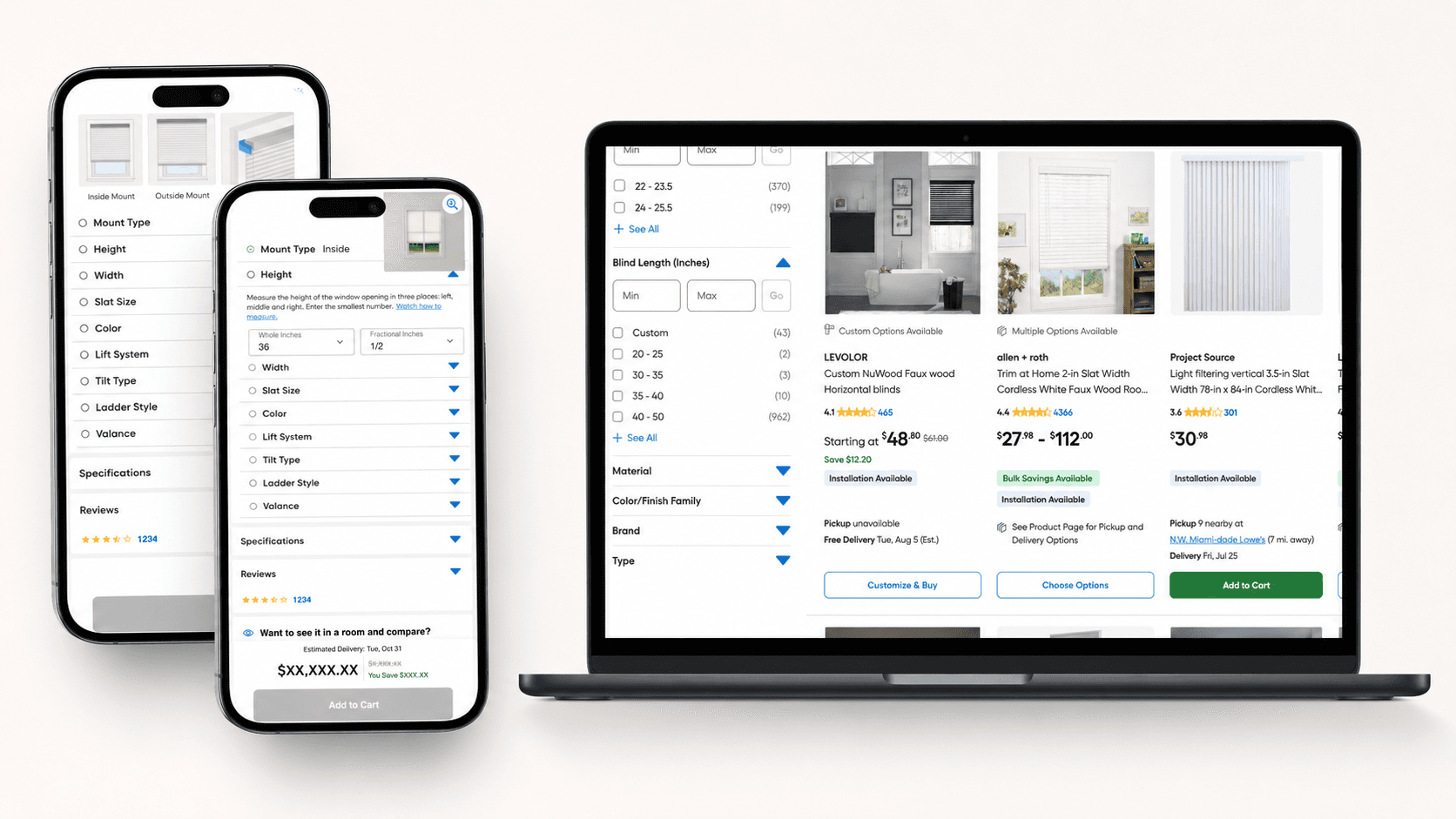
- Surfaced products on the list page so shoppers could understand the full assortment without hitting dead ends.
- Improved configurator clarity to reduce friction during customization.
- Prioritized guidance around the decision points that created the most hesitation, including product type, mount type, and measurement confidence.
- Created a shared roadmap that helped product, design, category, and merchandising teams align on where to invest next.
Leadership
What this case demonstrates about my leadership
This work demonstrates how I operate in ambiguous product spaces: I clarify the decision, design a research plan around the risk, triangulate multiple customer signals, and turn findings into a roadmap teams can act on.
The value was not just the research output. It was the alignment created across teams that needed to make coordinated decisions about a complex, high-consideration customer journey.
This work is summarized and anonymized due to confidentiality. Some visuals are omitted. Happy to walk through deeper specifics in an interview.