
This program set out to reimagine the Venus disposable razor for a competitive mid-tier segment where price, value perception, and in-use control heavily influenced choice.
As the User & Products Researcher, I led consumer research to understand what drove appeal before purchase and confidence during use, then translated those signals into handle design guidance the team could use to refine prototypes, avoid unnecessary cost, and move a winning direction toward molding assessment.
Role
User & Products Researcher
Timeline
6 months
Budget
$90K
Team
Senior Brand Manager, Brand Analytics & Insights, Project Manager, Industrial Designer, Product Designer, Program Manager
Stakeholders
Marketing VP, Brand Director, R&D VP, Product Supply VP
Product context
Mid-tier women's disposable razor innovation
Business objective
Develop a competitive proposition to beat Bic Soleil and support a step change in sustainability.
Methods
Research outputs
- Product attribute framework
- FMOT and SMOT design guidance
- Prototype ranking and usability feedback
- Handle design recommendation
- Molding assessment recommendation
Why this mattered
Winning in a price-sensitive, high-competition category
Disposable razors are a highly competitive, price-sensitive category. To win against the category leader, the team needed more than a visually appealing handle. The product had to communicate value at shelf, feel comfortable and controlled in hand, and support a more sustainable refillable cartridge behavior without introducing friction into the grooming routine.
The research needed to connect consumer perception, physical handling, and design feasibility so the team could make sharper tradeoffs before investing in tooling.
Decision supported
Which handle design cues should the team prioritize to improve shelf appeal, perceived value, comfort, and in-use control while staying within cost and manufacturing constraints?
My research strategy
From broad category understanding to handle design decisions
I structured the research to move from broad category understanding to specific handle design decisions.
Define the constraints
Aligned the research plan around launch timing, handle-only design scope, North America as the lead design market, global execution needs, and financial constraints.
Understand what drives appeal
Used literature review, perceptual mapping, and interviews to identify which visual and tactile cues shaped the first moment of truth and early product preference.
Translate perception into design criteria
Connected consumer language to product attributes such as shape, handle curvature, elastomer placement, weight, grip, and perceived control.
Iterate toward a winning direction
Used prototype ranking and usability testing across two design rounds to refine form, elastomer placement, and handling before recommending a direction for molding assessment.
The framework
Designing for two moments of truth
First moment of truth · before purchase
“Does this look worth buying?”
Key cues
Design guidance
- Avoid cutouts that reduce perceived value.
- Use curved forms and a more substantial handle.
- Signal comfort through visible grip and soft-touch cues.
Second moment of truth · during use
“Does this feel secure, comfortable, and controlled?”
Key cues
Design guidance
- Support finger anchoring.
- Use a larger circumference where appropriate.
- Place elastomer where it improves grip and confidence.
Discover phase
Identifying the cues that drive appeal and control
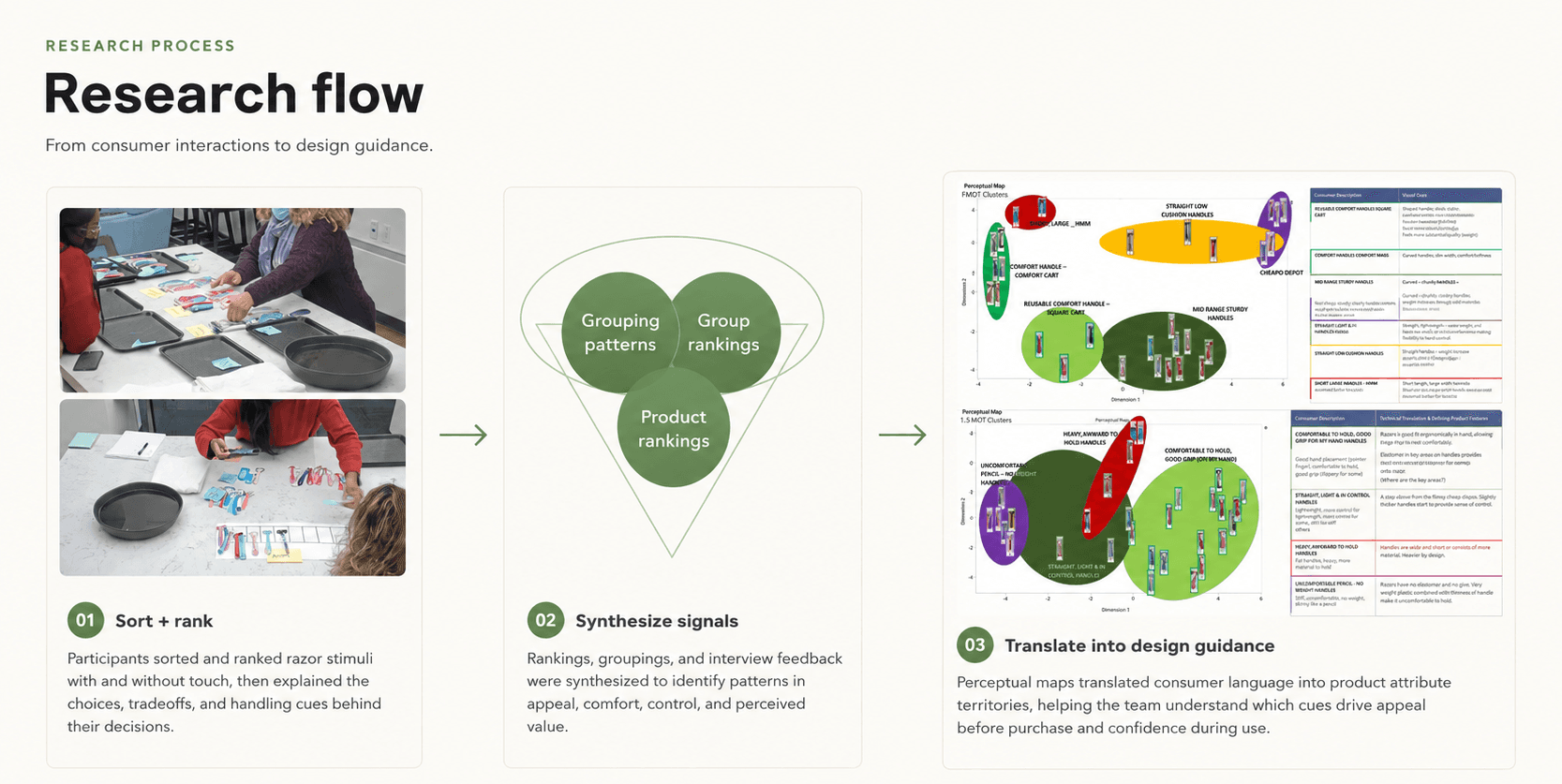
In the discovery phase, I used perceptual mapping and 12 in-depth interviews to understand how women grouped, ranked, and described different razor handles before and after touching them. This helped the team separate what drove visual appeal from what drove in-hand confidence.
Key output
An attribute framework that translated consumer language into design guidance for value, shape, comfort, grip, and control.
Study setup
- 12 participants
- 1:1 interviews
- 90 minutes each
- Razor stimuli with different handle variables
- Sorting and ranking with and without touching
- Qualitative discussion to understand the reasoning behind choices
What we learned
Four insights that shaped the design direction
Value had to be communicated before use.
Why it mattered
In a price-sensitive disposable category, shoppers needed visual cues that made the product feel worth the price before they ever touched it.
Design implication
Avoid design details that lowered perceived value, such as cutouts that could signal less material or collect grime. Use form, finish, and visual completeness to support value perception.
Comfort and control were distinct but connected needs.
Why it mattered
Consumers wanted the razor to feel comfortable in hand, but they also needed the handle to communicate control during shaving.
Design implication
Prioritize handle shape, curvature, and grip cues that create both comfort and a sense of secure handling.
Elastomer placement mattered more than simply adding soft material.
Why it mattered
Elastomer needed to support finger anchoring and prevent slippage, not just appear as a comfort feature.
Design implication
Place elastomer where fingers naturally anchor, especially along the lower handle and key grip zones.
The team could improve the experience without reinventing everything.
Why it mattered
Given financial and manufacturing constraints, the team needed to focus on design changes that could create consumer-perceived improvement without unnecessary complexity.
Design implication
Use an existing handle design as the starting point and apply targeted changes to form, thickness, curvature, and grip.
Explore phase
Narrowing prototype direction through consumer feedback
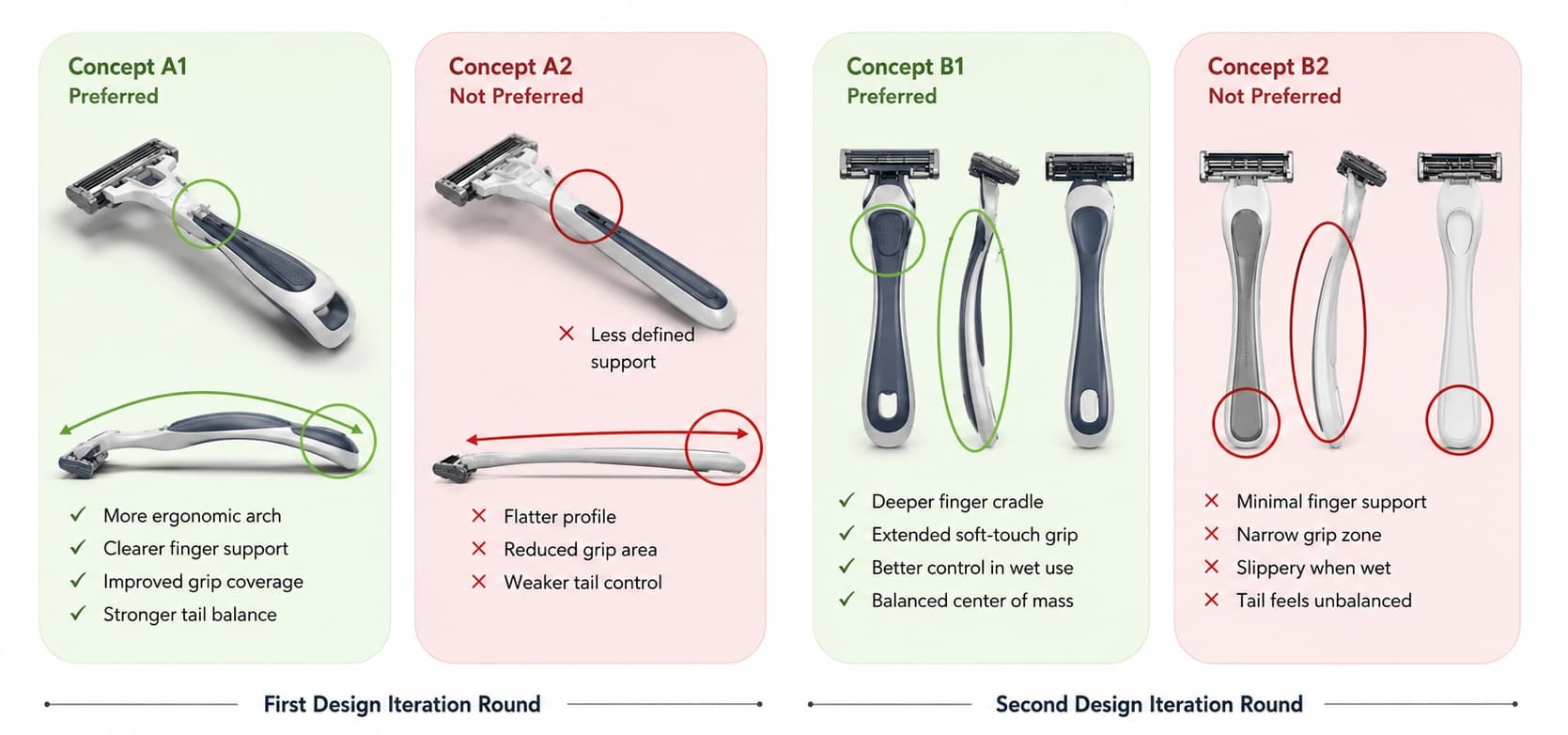
After discovery, the team created low-fidelity prototypes based on the strongest consumer signals. I then supported two rounds of prototype evaluation to understand which forms, grip placements, and handle cues best delivered appeal, comfort, and control.
Recommendation
Pass the winning design to the molding team for assessment and sample tooling.
Study setup
- 20 participants per design round
- 1:1 sessions, 30 minutes each
- First round focused on form
- Second round focused on elastomer placement
- 6 form prototypes plus 3 controls
- 6 elastomer positioning prototypes plus 4 controls
The output
Design guidance delivered to the team
Start from a proven handle form
Use a current handle design as a baseline, then apply targeted improvements instead of starting from scratch.
Signal value through complete, sturdy form
Avoid visual cues that imply cheapness or reduced material. Use a more complete handle shape to strengthen perceived value.
Create a stronger sense of control
Prioritize curvature, thickness, and grip zones that make the handle feel secure and controlled during use.
Place elastomer where it works hardest
Use elastomer for finger anchoring and anti-slip confidence, not simply as a decorative comfort cue.
Research contribution
How I contributed
- Built a foundational understanding of disposable razor users, including what drove appeal before purchase and confidence during use.
- Translated consumer perception into concrete handle design guidance around value cues, shape, grip, comfort, and control.
- Helped the team avoid unnecessary cost increases by identifying design changes that could improve the experience without overcomplicating the product.
- Informed prototype selection and gave the molding team a clearer consumer-backed direction to assess.
- Contributed to a product learning plan designed to help Venus compete more effectively against Bic Soleil.
Impact
Business and product impact
Created a consumer-backed innovation direction
Developed a clearer understanding of disposable razor users and the product attributes needed to compete against Bic Soleil.
Reduced design and tooling risk
Helped the team focus on targeted handle design changes before moving a winning direction into molding assessment.
Protected cost discipline
Identified experience improvements that could increase perceived value and control without unnecessary product complexity or cost escalation.
Translated perception into product criteria
Connected consumer language around comfort, control, and value to specific design requirements for form, grip, elastomer placement, and handle feel.
Why it belongs here
What this case demonstrates today
Although this was earlier-career work, it remains important to my portfolio because it shows the foundation of how I approach research: clarify the decision, understand the customer context, translate behavior and perception into product criteria, and help teams make better tradeoffs.
This case also shows the range of my research background. Before leading digital UX research across e-commerce journeys, I was trained in consumer product innovation, where research had to connect what people say, what they feel, what they choose, and what a team can realistically build.
Reflection
What I would carry forward
- Be disciplined about stimuli volume so participants can give high-quality feedback without fatigue.
- Build in analysis time early, especially when combining rankings, perceptual maps, and qualitative interviews.
- Revisit research questions after each learning phase so the plan can adapt as stronger signals emerge.
- Balance rigor with speed when product teams are working toward manufacturing and launch milestones.
This work is summarized and anonymized due to confidentiality. Some visuals are omitted or abstracted, and I'm happy to walk through deeper specifics in an interview.