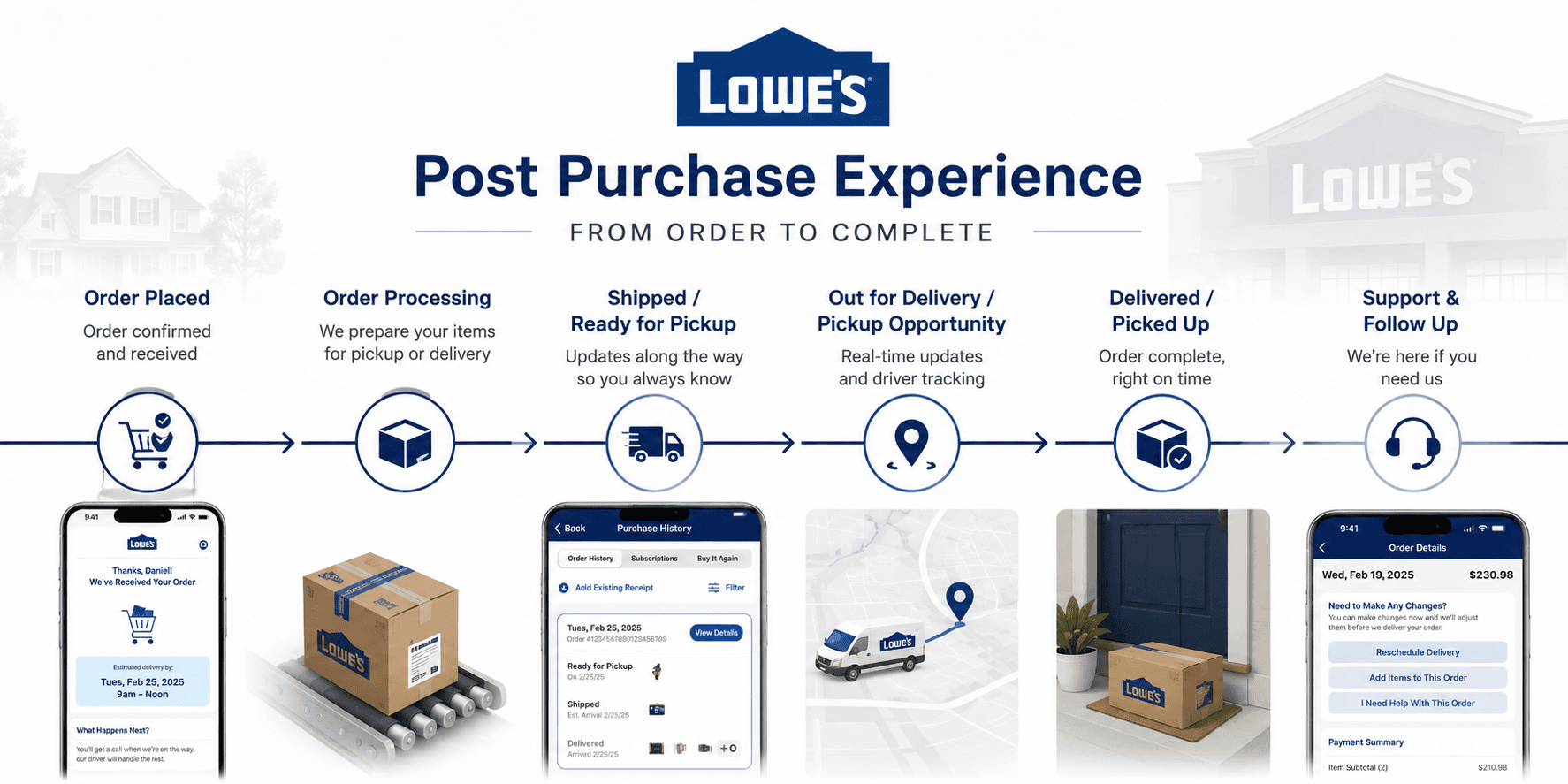
Post-purchase is where customer trust is either reinforced or lost. For Lowe's, order management, fulfillment visibility, and issue resolution were not just support moments, they were retention moments tied to churn risk, service costs, and long-term revenue.
I co-led a 3.5-month research initiative to diagnose the customer and business drivers behind post-purchase friction, align cross-functional teams on the problems worth solving, and shape roadmap priorities across order confirmation, order history, order details, and future-state online exchanges.
Role
Sr. UX Researcher, Project Co-Lead
Timeline
3.5 months · 2024 to 2025
Team
Lead Designer, 3 Mid-Level Designers, 2 Content Strategists
Stakeholders
- 4 Bottom-Funnel Product Managers
- Fulfillment Product Manager
- Engineering Leadership
Methods utilized to diagnose & prioritize
Workstreams
- Order confirmation and status visibility
- Order history and order details IA
- Item-level support information
- Online exchange / issue resolution North Star
Core outputs
- Churn driver synthesis
- Prioritized problem statements
- IA and content priorities
- Research-informed design recommendations
- Future-state exchange concept validation
Why this mattered
An overlooked, high-leverage moment in the journey
Post-purchase was an overlooked but high-leverage part of the customer journey. Customers were not only checking order status, they were looking for reassurance, clarity, and a path to resolve issues when something went wrong.
When customers could not find the right information or fix order problems on their own, the experience created avoidable service contacts, frustration, and risk of future churn. This made post-purchase a strategic opportunity to protect trust, reduce operational burden, and support repeat purchase.
Decision supported
Where should Lowe's invest across the post-purchase journey to reduce churn risk, lower avoidable service contacts, and improve customers' confidence after purchase?
My research strategy
Moving from broad churn signals to specific product decisions
I structured the research plan so each phase answered a distinct question the team needed resolved before it could act.
Diagnose the business risk
Used Medallia journey analytics and churn signals to identify which parts of the post-purchase journey were most connected to dissatisfaction and customer loss.
Understand the customer experience
Used interviews and survey data to understand what customers needed after purchase, where they felt confused, and why they turned to customer service or competitors.
Prioritize the problems worth solving
Led synthesis and problem-definition work to turn scattered insights into two core customer problems: customers did not have the information they needed, and customers did not have a clear way to fix issues.
Validate direction and reduce design risk
Used card sorting and usability testing to refine IA, content hierarchy, order-management flows, and future-state exchange concepts before deeper investment.
The research logic
From customer signals to product direction
Customer signals
- Medallia feedback
- Churn survey data
- Interviews
- Card sorting
- Usability testing
Synthesized into
- Churn drivers
- Customer jobs
- Problem statements
- IA priorities
- Design risks
Informed decisions across
- Order confirmation
- Order history
- Order details
- Item details
- Online exchanges
The post-purchase journey
The questions customers needed answered at each step
“Do I know my order was received and what happens next?”
“Can I quickly find the order I need?”
“Can I understand status, fulfillment, and available actions?”
“Can I find information specific to what I bought?”
“Can I fix a problem without calling support?”
“Do I trust this retailer enough to come back?”
What we learned
Four insights that reframed post-purchase
Post-purchase friction was a churn risk, not just a support issue.
Why it mattered
Customer frustration after purchase could weaken trust, increase support reliance, and reduce the likelihood of future shopping.
Product implication
Post-purchase needed to be treated as a retention experience, not just a place to display order information.
Customers did not have the information they needed at the moment they needed it.
Why it mattered
Customers wanted clarity on order status, next steps, item-specific information, fulfillment details, and support options.
Product implication
Order confirmation, order history, and order details needed clearer hierarchy, more relevant content, and easier access to item-level information.
Customers did not have a clear way to fix order issues.
Why it mattered
When the only visible path was a return or a customer service contact, customers lacked confidence that Lowe's could help resolve their issue.
Product implication
The experience needed clearer self-service resolution paths, including a broader 'Fix an Issue' entry point beyond returns.
Different customers needed different post-purchase pathways.
Why it mattered
DIY and Pro customers had different needs across order visibility, fulfillment, support, and repurchasing.
Product implication
IA and content priorities needed to account for distinct customer jobs instead of assuming one universal order-management flow.
Problem definition
The problems worth solving
The research helped the team move from a broad churn problem to two actionable experience problems that could guide roadmap, IA, and design priorities.
Customers don't have the information they need.
Customers lacked clear, timely, item-specific information about their orders, next steps, fulfillment status, support options, and post-purchase actions. This created confusion, avoidable support contacts, and reduced confidence after purchase.
Customers don't have a clear way to fix issues.
When something went wrong, customers struggled to understand their options. Limited self-service paths and return-centered flows made issue resolution feel unclear, increasing frustration and reliance on support channels.
Prioritization
Turning insights into roadmap priorities
The research created a shared prioritization framework for UX, Product, Fulfillment, Content, and Engineering. Instead of treating post-purchase as a single page redesign, the team aligned around the customer jobs that needed to be supported across the journey.
Reassure customers immediately after purchase
Focus. Order confirmation, next steps, fulfillment expectations, communication consistency.
Help customers find and understand their orders
Focus. Order history IA, status clarity, fulfillment distinctions, and item-level details.
Give customers a clearer path to resolve issues
Focus. Dynamic CTAs, self-service support, common questions, returns, exchanges, and 'Fix an Issue' pathways.
Business impact
Measured results after the experience updates
Measured by the product team after the post-purchase experience updates shipped, the work improved clarity, self-service resolution, and retention.
-12%
Call volume
Reduction in avoidable service contacts through clearer information and self-service paths.
+$14M
Saved sale revenue
Revenue protected by reducing friction after purchase.
The outcome
How the research shaped the customer experience
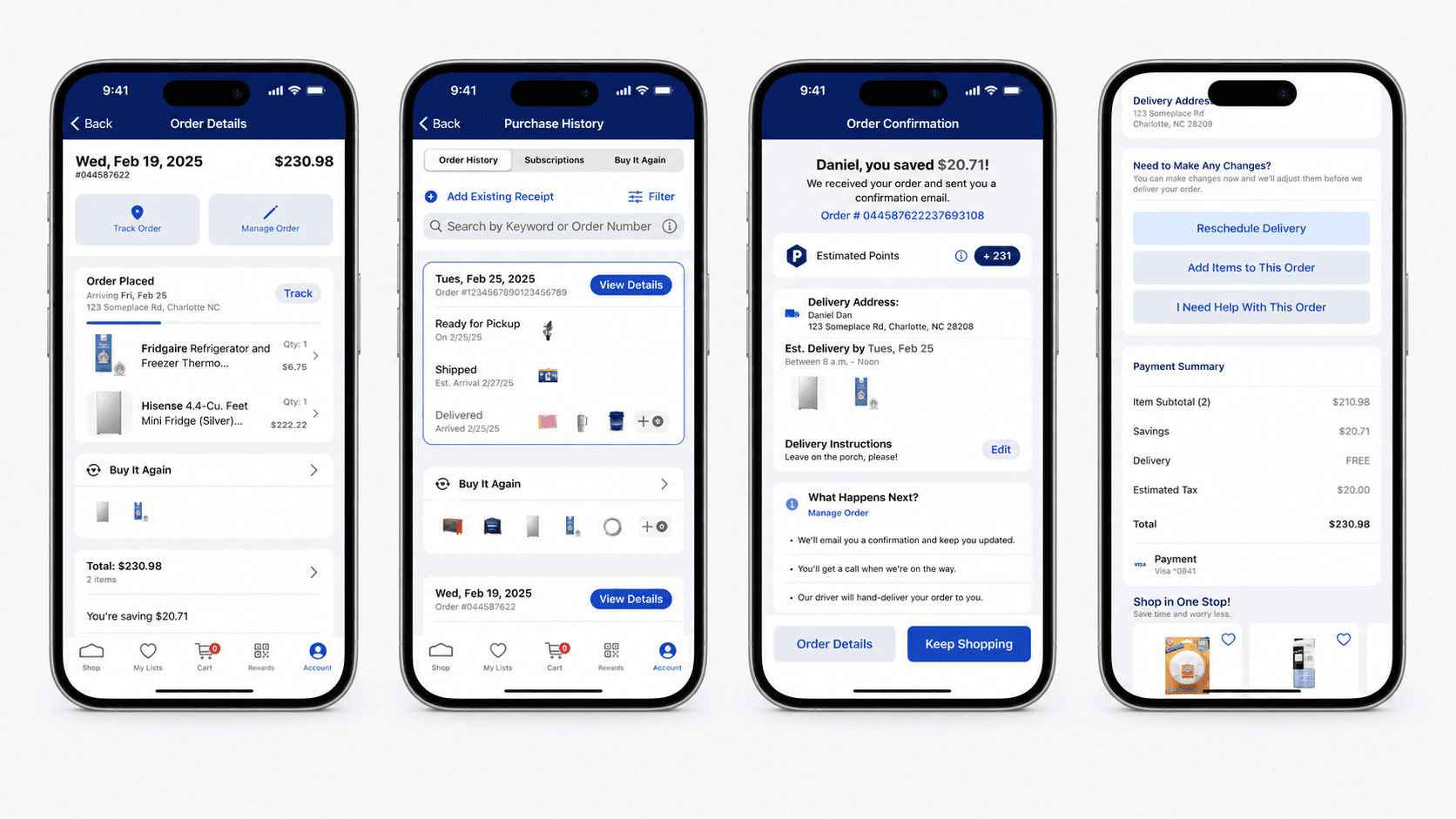
Order confirmation became a reassurance moment.
- Created consistency between the confirmation email and confirmation page.
- Surfaced essential order information above the fold.
- Added clearer next steps and fulfillment expectations.
- Made delivery instructions and order modification entry points easier to access.
Order history became easier to scan and act on.
- Simplified the page name based on quantitative survey results.
- Prioritized the primary job of checking order status before repurchase prompts.
- Created clearer distinctions between multiple fulfillments in one order.
- Removed lower-priority information from order cards to better match customer needs.
Order details became more action-oriented.
- Added dynamic CTAs based on pre- and post-fulfillment needs.
- Tailored common questions to reduce avoidable customer service contacts.
- Created an Item Details sub-page for product-specific post-purchase information.
Item details gave customers a place for product-specific support.
- Added access to protection plan information and claims entry points.
- Included configured item details, return policies, and downloadable manuals.
- Helped customers find support information tied to the specific item they purchased.
Extending the strategy
A North Star for online exchanges
Once the team aligned on the need for clearer post-purchase information, the next strategic question became how Lowe's should help customers resolve issues without defaulting to support calls or returns.
I led research for a future-state online exchange concept in an area where no mature self-service experience existed. Using competitive analysis, Baymard guidance, and unmoderated usability testing, I helped the team evaluate a North Star direction for flexible issue resolution.
Broaden the entry point from 'Start a Return' to 'Fix an Issue'.
Use customer-friendly language for issue selection.
Recommend solutions based on the issue selected.
Clearly explain what happens during an exchange.
Provide confirmation, next steps, and tracking after initiation.
Leadership
What this case demonstrates about my leadership
This case shows how I operate when the problem is bigger than a single flow. I connected customer churn signals to product strategy, translated messy feedback into clear problem statements, and helped cross-functional teams align on where to invest.
The value was not only the research output. It was the decision clarity created across Product, Design, Content, Fulfillment, and Engineering, helping the organization see post-purchase as a strategic lever for retention, trust, and revenue protection.
Need clarity on a high-friction customer journey?
I support teams that need to diagnose customer friction, prioritize the problems worth solving, and translate research into roadmap-ready recommendations.
This work is summarized and anonymized due to confidentiality. Results were measured by the product team after the experience updates shipped. Happy to walk through deeper specifics in an interview.