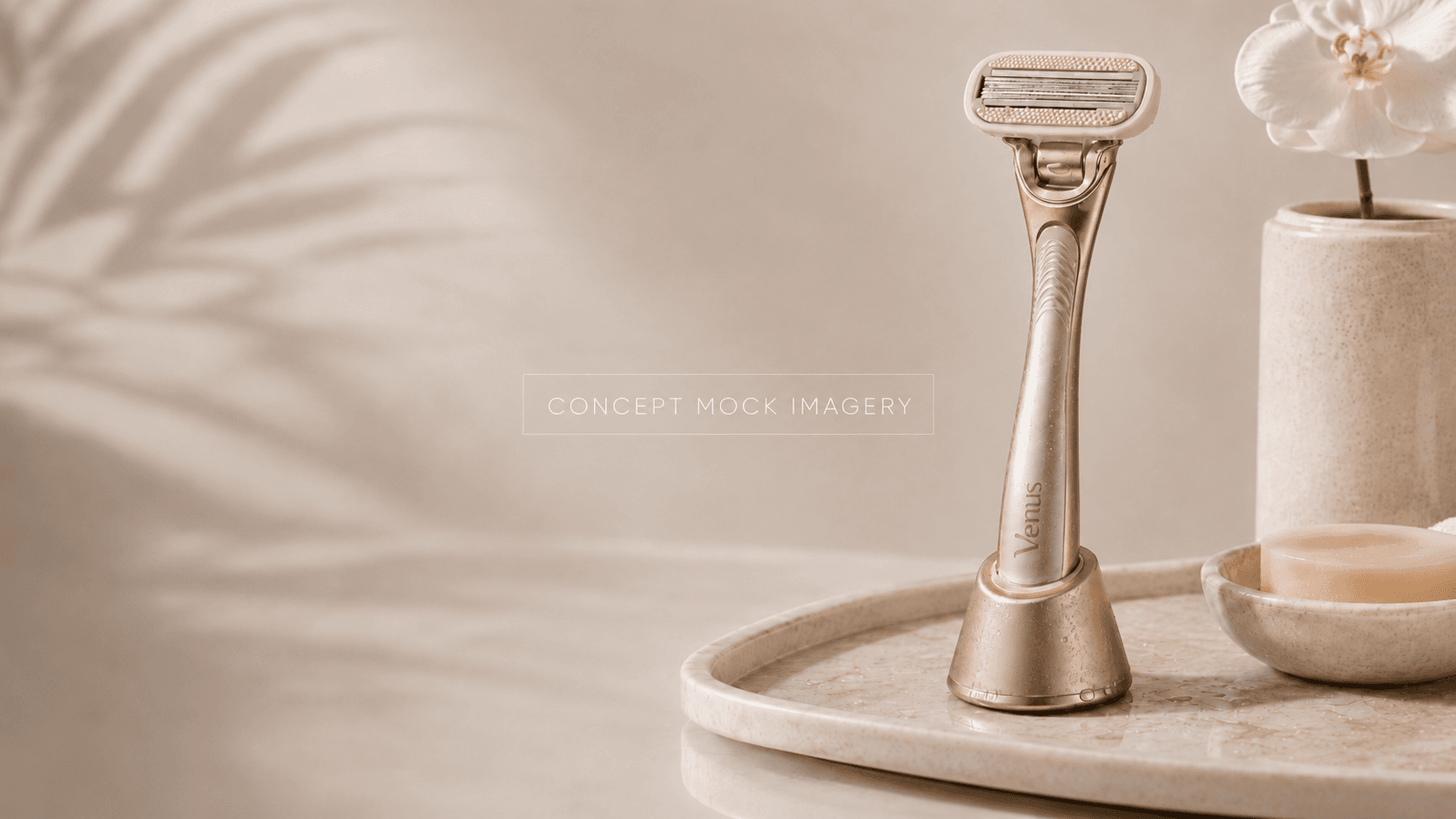
This 1.5-year innovation program explored whether Venus could establish a new premium tier in women's wet shave through an exfoliating razor benefit.
As the User & Products Researcher, I led consumer research across metaphorical elicitation, proposition testing, surveys, and a 9-week at-home diary study to understand whether the benefit was desirable, believable, and strong enough in use to justify a higher price point. The research revealed a critical gap between early proposition appeal and actual product performance, leading me to recommend that the program not continue under its current success criteria.
Role
User & Products Researcher
Timeline
1.5 years
Budget
$150K
Team
Senior Brand Manager, Brand Analytics & Insights, Project Manager, Finance Manager, Industrial Designer, Product Designer, Program Manager
Stakeholders
Marketing VP, Brand Director, R&D VP
Product context
Premium women's wet-shave innovation
Business objective
Establish a new standard of superiority and justify a $25 to $30 premium price tier.
Methods
Research outputs
- Unmet-needs framework
- Premium proposition feedback
- Benefit comprehension and appeal signals
- 9-week in-use performance read
- Recommendation on whether to continue under current success criteria
Key recommendation
Do not continue the program under the current success criteria without resolving the gap between expected exfoliation benefit and actual in-use performance.
Why this mattered
A premium claim has to survive real use
Premium innovation requires more than strong concept appeal. To justify a new price tier, the product experience has to deliver a benefit customers can recognize, value, and describe after real use.
For Venus, the exfoliating benefit had the potential to create a new standard of superiority, attract new users, and trade up current users. But the business risk was significant: if the benefit felt unclear, unnecessary, or inferior to the best existing cartridge, the team could invest behind a premium proposition that would not hold up in market.
Decision supported
Should Venus continue investing in an exfoliating razor as the basis for a new premium tier, and if so, what benefit language, design cues, and success criteria would make the proposition credible?
My research strategy
From unmet needs to real-world benefit validation
I structured the research to move from unmet-needs exploration to real-world benefit validation.
Define the premium opportunity
Aligned the research around the business question: could an exfoliating razor create a new standard of superiority and justify a premium price tier?
Explore unmet needs and benefit language
Used metaphorical elicitation and virtual interviews to understand the target user's desired shaving experience, emotional expectations, and language around smoothness, exfoliation, and premium care.
Test the holistic proposition
Evaluated razor, accessories, packaging, and benefit articulation to understand whether the premium concept felt desirable, credible, sustainable, and worth more.
Validate real-world performance
Used a 9-week at-home split-body diary study to test whether the product experience delivered against the exfoliation promise in actual use.
The strategic tension
Strong appeal, weaker proof
Early proposition research showed strong promise. Premium users responded positively to the sophisticated design, packaging, and elevated unboxing experience. Some participants described the handle as high quality and long-lasting, and the holistic proposition suggested the potential to command a higher price point.
But the critical question was not whether the idea sounded premium. It was whether the product experience could deliver a noticeable exfoliation benefit in real use. The diary study revealed that the benefit did not consistently meet expectations, and performance was not superior to the best-designed existing cartridge.
The research logic
The research evidence ladder
- 6 metaphorical elicitation interviews
- Desired experience and unmet-needs exploration
- 17 in-depth interviews
- Holistic proposition prototypes
- Razor, accessories, packaging, and messaging
- 30 participants
- 9-week at-home split-body diary study
- Handle and exfoliating bar evaluation
- Strong early premium appeal
- Weak benefit superiority in use
- Recommendation not to continue under current criteria
Explore phase
Testing the premium promise
In the explore phase, I used metaphorical elicitation, virtual interviews, and proposition research to understand what premium-minded women wanted from the shaving experience and whether Venus could credibly stretch into a more elevated benefit space.
Unmet-needs exploration
- 6 virtual 1:1 interviews, 60 minutes each
- Metaphorical elicitation with collage homework
- Participants reflected on current vs. ideal shaving experience
- Recruited women 18 to 40 who wet shaved with 5-blade refillable razors and spent on other hair-removal methods
Holistic proposition testing
- 17 1:1 interviews, 45 minutes each
- Holistic proposition prototypes: razor, accessories, packaging, and working product concepts
- Included acceptors of a newly launched product to understand cannibalization risk
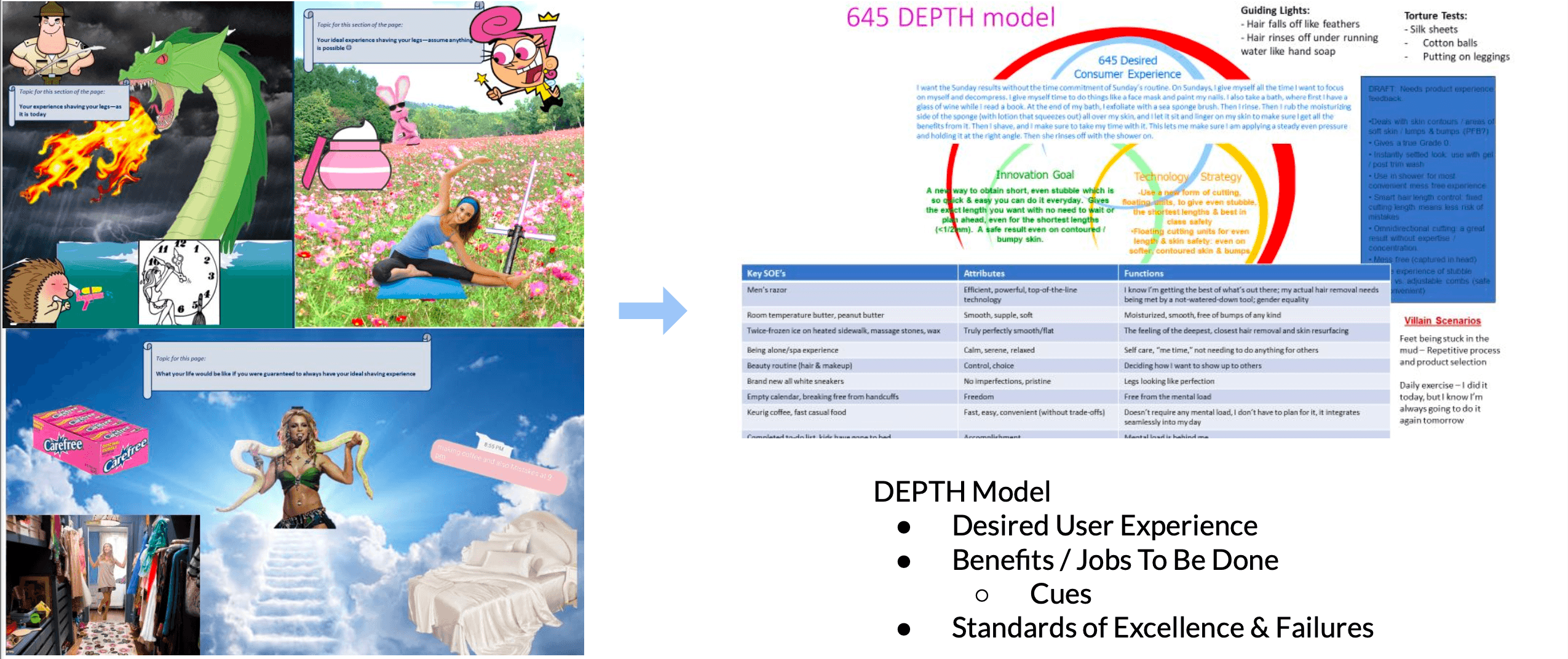
Key output
Early evidence suggested the premium design world was appealing, but the benefit needed real-use validation.
What we learned
Four insights that shaped the recommendation
The premium world was compelling.
Why it mattered
Participants responded to the sophisticated design, packaging, and unboxing experience. The proposition felt elevated, high-end, and more sustainable.
Product implication
The team had permission to pursue a more premium design language, but the product benefit still needed to earn the price.
Concept appeal did not guarantee benefit credibility.
Why it mattered
Consumers liked the idea of combining shaving and exfoliation, but liking the idea was different from believing the product delivered exfoliation in use.
Product implication
The team needed to validate the physical benefit experience, not just the proposition and packaging.
The exfoliation benefit was not strong enough in real use.
Why it mattered
Participants did not consistently feel the exfoliation experience, and some questioned whether exfoliation should happen every time they shaved.
Product implication
The current product design and benefit articulation did not meet the success criteria for a premium superiority claim.
The stronger opportunity was redefining smoothness.
Why it mattered
The research surfaced a more nuanced premium consumer desire: not just hair removal, but skin that feels even, refined, and texture-less.
Product implication
The team had an opportunity to evolve the benefit space and language beyond traditional smoothness or exfoliation claims.
Test phase
Where the evidence changed the recommendation
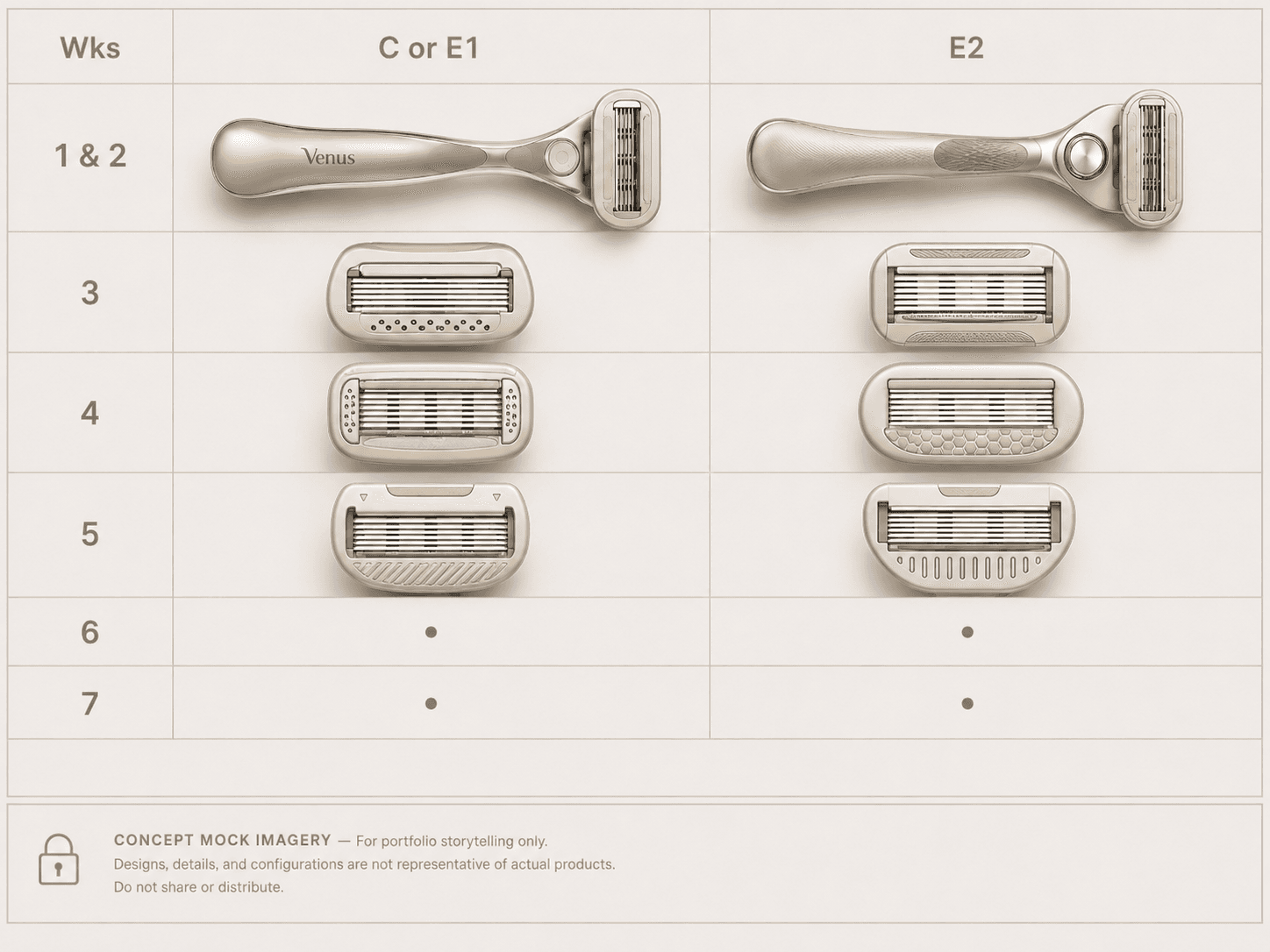
To separate proposition appeal from product truth, I led a 9-week at-home split-body diary study with 30 participants. This allowed the team to observe whether the exfoliation benefit held up over repeated real-world use, not just in concept exposure or short- session feedback.
What the diary study revealed
- The specific exfoliation bar pattern was relatively unimportant.
- Performance was not superior to the best-designed existing cartridge.
- There was a gap between expected exfoliation and experienced exfoliation.
- Users saw shaving and exfoliating as two separate rituals.
- Some users did not believe exfoliation should happen every time they shaved.
Study setup
- 30 participants over 9 weeks total
- 2 weeks focused on handle, 7 weeks focused on the exfoliation bar
- Weekly 1:1 check-ins with 5 users, 25-minute sessions
- Bar patterns selected from a previous online survey
- Split-body shave to compare performance
The framework
From premium promise to product truth
Premium promise
- Sophisticated design
- Elevated unboxing
- Sustainable cues
- Exfoliating benefit
- Higher price potential
In-use reality
- Benefit was not consistently felt
- Bar pattern was relatively unimportant
- Performance was not superior to the best current cartridge
- Exfoliation expectations did not match real usage routines
Strategic recommendation
- Do not continue under current success criteria
- Reframe the benefit space
- Explore 'texture-less' skin and credible premium smoothness cues
- Revisit success criteria and category-relative performance
The recommendation
A disciplined call backed by evidence
Based on the diary study evidence, I recommended that the program not continue under its current success criteria. The product experience did not yet deliver a strong enough exfoliation benefit to support the premium superiority claim.
Rather than forcing the proposition forward, the research redirected the team toward a more credible benefit space: premium smoothness defined less by exfoliation mechanics and more by the feeling of refined, even, texture-less skin.
Do not continue under current success criteria
The benefit did not deliver clear enough superiority in real use to justify the intended premium claim.
Revisit the success metrics
Relative category performance mattered more than overall liking, because the product had to outperform strong existing shave experiences.
Reframe the benefit language
Move from a literal exfoliation claim toward a more consumer-relevant articulation of smooth, even, texture-less skin.
Validate performance sooner
Bring real-use testing earlier when a proposition depends on a physical benefit customers must feel.
Research contribution
How I contributed
- Connected early premium proposition appeal to a deeper in-use validation plan so the team could evaluate whether the benefit was real, believable, and worth the price.
- Identified a gap between the exfoliating-bar technology and the desired and perceived benefit from actual product usage.
- Recommended not continuing the program under its current success criteria, protecting the business from investing behind a benefit that did not yet deliver superiority.
- Helped the team redefine the benefit space around 'texture-less' skin and upgrade how the brand thought about smoothness for the premium-minded consumer.
- Demonstrated that the strongest research contribution is sometimes helping a team stop, pivot, or reframe before launch.
Impact
Business and product impact
Protected investment quality
Recommended against continuing under the current success criteria, helping the team avoid investing behind a premium benefit that did not yet deliver clear superiority.
Separated concept appeal from product truth
Showed that an elevated proposition and packaging system could create excitement, but real-world performance needed to carry the premium claim.
Reframed the benefit space
Helped define a more consumer-relevant articulation around texture-less skin and upgraded smoothness for the premium-minded consumer.
Improved future research discipline
Clarified the need for category-relative success metrics, more inclusive recruit criteria, and earlier in-use testing when evaluating physical product benefits.
Why it belongs here
What this case demonstrates today
This case remains important to my portfolio because it shows that my research judgment is not limited to validating ideas. I am comfortable using evidence to challenge momentum, protect investment quality, and help teams make disciplined product decisions.
It also shows how my consumer products background strengthens my UX research practice today. I learned to evaluate not only what people say they want, but whether a product experience actually delivers the promised value in context.
Reflection
What I would carry forward
- Use category-relative performance metrics when the business goal is superiority, trade-up, or premium pricing.
- Pressure-test recruit criteria early so the participant base reflects the full target market, not only the easiest-to-reach users.
- Bring in-use testing earlier when the value proposition depends on a physical benefit customers need to feel.
- Distinguish between proposition appeal, message comprehension, and actual product performance.
- Treat a 'no' recommendation as a strategic outcome when it protects the business from weak product-market fit.
This work is summarized and anonymized due to confidentiality. Some visuals are omitted or abstracted, and I'm happy to walk through deeper specifics in an interview.